HORIBA Group invites executives and representatives from key suppliers to its headquarters and works to strengthen trust-based partnerships through ongoing communication.
We regularly share our management policies, business plans, and procurement strategy to the extent that they can be disclosed. We also exchange views on important procurement-related topics, such as respecting human rights, reducing environmental impact, ensuring information security, and managing risks, while explaining our views and expectations.
Through these direct conversations, we deepen our understanding of CSR procurement and strengthen efforts throughout the supply chain.
We held a sustainability workshop for the next generation of leaders from key suppliers. First, the relevant HORIBA department explained our decarbonization efforts across the supply chain. Next, participating companies reported on specific examples of their own initiatives. Finally, as a practical exercise, participants learned how to calculate GHG emissions (Scope 1 and Scope 2)*1.
Participants said that they had gained a better understanding of the importance of reducing CO2 emissions, found the examples of initiatives being undertaken by other companies very helpful, and would like to pursue SBT certification*2.
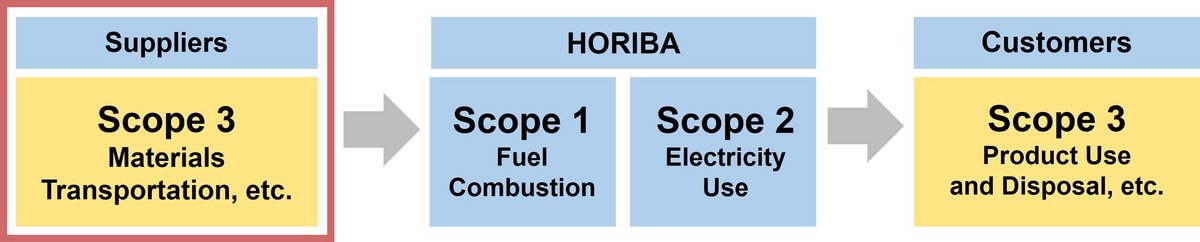
*1 GHG emissions (Scope 1 and Scope 2): Scope 1 refers to greenhouse gas emissions released directly from a company’s activities, such as fuel combustion. Scope 2 refers to indirect greenhouse gas emissions associated with the generation of purchased electricity, heat, and other forms of energy consumed by a company.
*2 SBT certification: This refers to submitting a company’s greenhouse gas reduction targets to the Science Based Targets initiative (SBTi) for validation and having them approved.
At HORIBA Group, reducing CO2 emissions across the entire supply chain is a major priority in our efforts to achieve carbon neutrality by 2050. As part of this effort, we are working with key suppliers to collect primary data*3 on Scope 3 (Category 1) emissions*4.
In the first step, we conducted a questionnaire on CO2 reduction to understand the current situation and challenges. In the second step, we held online briefing sessions and individual consultations, and suppliers provided the necessary data related to their production activities wherever possible. We are currently considering our future approach based on the information collected and feedback from suppliers regarding practical implementation.
This initiative represents an important first step, and we will continue working to improve its effectiveness.
*3 Primary data: Basic emissions data obtained directly from suppliers, such as actual measured values, that are used to calculate emissions.
*4 Scope 3 (Category 1): CO2 emissions associated with purchased goods and services.
To help reduce CO2 emissions across the supply chain, we encourage our suppliers to make use of energy-saving assessments so that they can better understand their own energy performance.
Through these efforts, more suppliers in Japan are undergoing energy-saving assessments and considering energy-saving measures. Some suppliers have also used subsidy programs as an opportunity to upgrade to high-efficiency air-conditioning equipment, convert to LED lighting, and install solar power systems. In addition, interest is growing in obtaining SME SBT*5 (Science Based Targets) certification, which helps companies make their efforts to reduce CO2 emissions visible.
*5 SME SBT: A greenhouse gas target-setting program developed by the Science Based Targets initiative for small and medium-sized enterprises.
As part of our efforts to help create a sustainable society, we are working with key suppliers to promote responsible sourcing throughout the supply chain. To understand the status of initiatives in important areas such as labor, occupational health and safety, the environment, and ethics, and to support continuous improvement, we conduct ESG questionnaires.
These questionnaires are not intended to serve as audits or ratings. Rather, they are designed to promote mutual understanding and support improvement through dialogue.
The questionnaire covers six areas and approximately 50 questions, including management systems and resilience in addition to the important areas mentioned above. The questionnaire uses a five-point rating scale and includes a simple free-text section, enabling us to review suppliers’ initiatives from multiple perspectives. Based on the responses, we hold individual discussions as needed and exchange views on how to improve.
We received active and positive feedback from all participating suppliers, and the constructive discussions marked a major step forward. We plan to follow up on progress in implementing improvements over the next several months, up to approximately six months, with a view to providing advice and support. Going forward, we will continue to work closely and thoughtfully with our suppliers, supporting them in making improvements in a practical and manageable manner while strengthening the foundation for sustainable procurement and building a responsible supply chain.